

Why debate, while sometimes diverting, is ultimately useless.

Whisper 2014
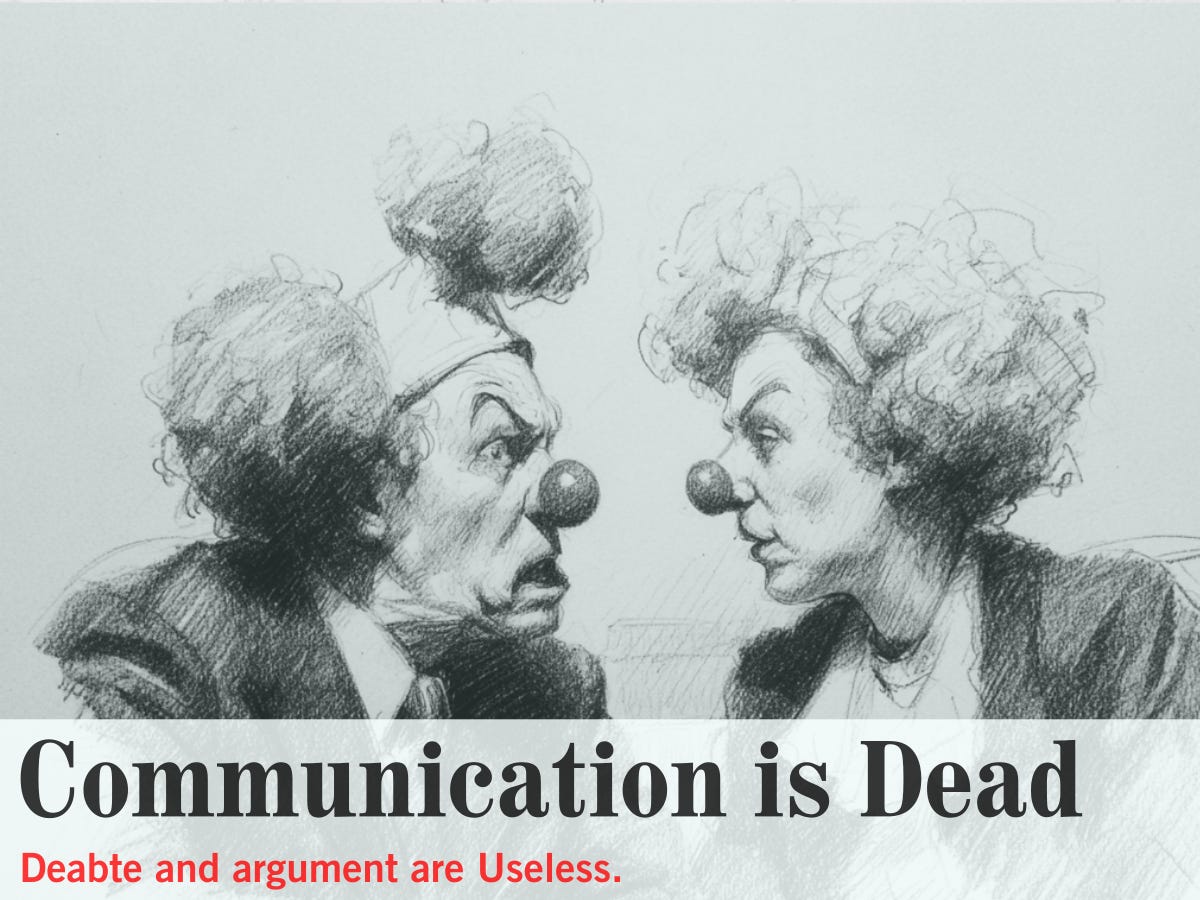
You're expecting me to say that no one will ever change anyone's mind but the issue runs deeper than that.
Men and Women end up talking past each other because they cannot even agree on what they should be debating about. The sets of values they hold are completely disjoint. They cannot even agree on what a "debate" is, and what the goals of a "debate" are.
Men generally bring the following assumptions to a debate:
They believe that there is exactly one reality, and that truth is what accurately describes that reality. The better a statement describes reality, the more true it is. They are factual absolutists.
They believe that whether something is "good" or "bad" is a matter of opinion, and that all systems of morality are things societies invented to get a result, and it is therefore pointless to argue about whether something is "evil" or not, instead of about what effect it has. They are moral relativists.
They believe that the goal of a debate is to establish what the facts are, and how this knowledge can be used to control outcomes. They argue about what is true.
They believe that debates are a cooperative process between two or more people who have the shared goal of achieving a more accurate picture of absolute reality, and that, while people may stick vehemently to their positions, they can also reverse them on a dime if new information comes to light, because the only real attachment is to the truth. They believe debates occur between theories, not people. Thus questioning someone's character is off-limits, because it is irrelevant.
Women generally bring the following assumptions to a debate:
They believe that reality is subjective, and what is "true" is simply a matter of who you ask. What is called "truth" is simply a codification of someone's perspective, and it is therefore pointless to argue about what is "true". They are factual relativists.
They believe that there is exactly one set of moral laws, which human beings have gradually discovered in a historical climb towards ethical perfection. Certain people are ethically better or worse based not only on what they do, but also on what they believe. They believe that different ethical systems exist, but they can be ranked from ethically worst to ethically best based on a sort of meta-ethics whereby they can be tested for degree of compliance with the one absolute set of ethics that underlies reality. They are moral absolutists.
They believe that the goal of debate is to establish what is morally better, and what everyone should do. They argue about what is right.
They believe that debates are a competitive process between two people, who each have the goal of establishing their views about right and wrong by attaining a state of moral ascendancy over the other person. They believe that anyone who changes their views in revealing a flaw in their moral character (because their previous views were not morally correct), and must thereafter relinquish the moral high ground and submit their actions to the moral judgement of others (usually the person who won the debate). They believe debates occur between people, not ideas, for the precise purpose of establishing who should be allowed to set standards for the behavior of others (because they are morally superior). Thus, questioning someone's character is not only relevant, it's the whole point.
This is why women think men are "misogynists" or bad people. Because they cannot imagine an analysis that does not occur for the purposes of judgement, much less one that doesn't include any idea about what people "should" do.
This is why men insist women are willfully blind. Because, to them, anyone who doesn't admit the truth must be unable to perceive it. They cannot imagine anyone not caring what the truth is.
This is why women think men are trying to restore Dark Ages. They cannot imagine any group with shared views not having one moral agenda that they wish everyone to abide by.
This is men think women must be hopelessly bad at understanding human social structures. They cannot imagine anyone not wanting to do things in the most effective possible way.
Thus men and women cannot even agree on what to argue about.
The debate is rather tedious up until BP's parting shot.
BP says "All this so you can justify getting laid.". BP thinks RP is trying to "justify" something according a set of moral rules, because to BP, every act has a moral valance, and anyone who wishes to do anything must at least be ready with a moral excuse.
RP has been arguing, meanwhile, about which metaphors best illustrate human social and mating dynamics. RP does not address the issue of right or wrong at all, and seems to believe BP is engaging with him on factual level.
It is for this reason that arguing is pointless. Men think right and wrong are a matter of opinion, and women doesn't care what the facts are.
You should write your own essay on this instead of hijacking mine and link it to everyone
Aaron Cleary describes the sexual marketplace as dysfunctional nowadays because sellers demand too high a price, buyers will only buy for lower and no transaction takes place. This now is the psychological-philosophical underpinning of that economic phenomenon. I was going to write "the problem is..." but no problem, just a thought: the more I understand women, the less desire I have to engage with them, excluding the physical. Because what you describe here mirrors my life experience but makes talking to them pointless. Talking to them becomes narcissistic exercise since 1. they only talk with me because of vertical hierarchy, not shared interest (the thing), 2. since their interest in the "thing" is limited by the social-intersexual frame they attach to it, this severely hampers their ability, already low to begin with, to creatively add to the subject at hand.
Going to re-read Rollo book 4 and then Evola's metaphysics of Sex in that order, but later since I am omw to breakfast with a.... woman :D